
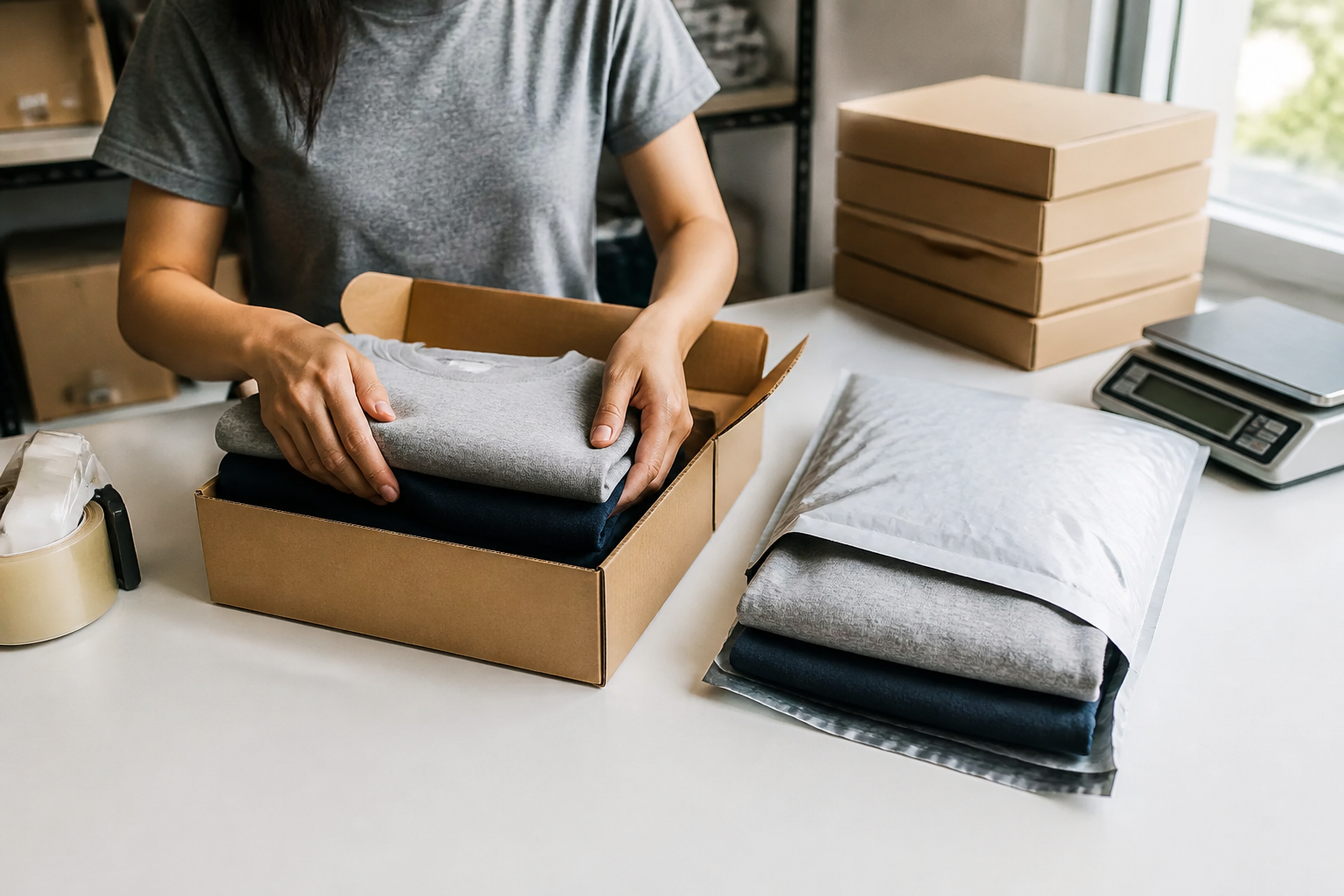
Key Takeaways
- Ditch the padded envelope once an order includes more than one item — mailer shipping boxes cut damage claims on multi-item apparel orders far more than an extra layer of bubble wrap ever will.
- Match dimensional weight to actual garment bulk before picking a size — a custom size mailer box that’s an inch too big wastes postage on every single order you ship.
- Save the poly or padded envelope for a single folded tee or scarf under a pound. That’s genuinely the one scenario where a bag beats a box on cost.
- Low minimum order quantities and no die charges mean custom mailer boxes with logo now make sense for sellers moving 50 to 1,000 orders a month, not just the big catalogs.
- Request free samples before committing to a wholesale run — testing fit and flute strength against your actual product beats guessing from a spec sheet every time.
- Track your return rate for 30 days after switching from envelopes to boxes. That number, more than any per-unit price, tells you whether the switch paid off.
Ask any apparel seller who’s checked their damage claims lately: something’s shifted. Poly mailers and padded envelopes used to be the default for shirts, hoodies, and folded goods under 5 pounds — cheap postage, thin profile, done. But return rates tell a different story right now, and a growing number of sellers are quietly moving back toward mailer shipping boxes, even for soft goods that technically don’t need rigid protection.
Here’s what’s driving it. A crushed corner on a poly mailer doesn’t just mean a refund — it means a one-star review with a photo attached. Multi-item orders shift inside a bag in ways they never do inside a properly sized box. And with USPS Ground Advantage now the default for most first class package shipments, handling isn’t always gentle.
So which one actually makes sense for your order profile?
That depends on weight, item count, and how much your unboxing experience matters to repeat buyers.
The Real Question: Padded Envelope or Mailer Box for Sub-5-Pound Apparel Orders
Picture a Tuesday morning: a seller ships 40 t-shirt orders, half in poly-padded envelopes, half in small boxes. Three weeks later, two envelope shipments come back — crushed corners, a torn seam, one customer swearing the shirt arrived “folded like a taco.” That’s not a hypothetical. That’s a pattern showing up in damage logs across apparel sellers moving 200 to 800 orders a month.
Here’s the real question nobody frames clearly enough: it’s not just protection versus cost. It’s protection, cost, and brand presentation, all fighting for the same few ounces of package weight. A padded envelope runs cheaper per unit and slides through USPS First-Class rates nicely. A box costs a bit more but holds shape, resists crushing, and photographs better on unboxing videos.
And that’s exactly why more apparel brands are rethinking the envelope-only approach. Return rates tied to “item damaged in transit” have climbed enough that several sellers report a measurable dip after switching folded goods into rigid packaging. Mailer shipping boxes are getting a second look precisely because they close without tape, stack cleaner in fulfillment bins, and hold their shape through USPS ground handling in ways soft mailers simply can’t.
So which one actually wins for a five-pound hoodie order? Depends on what’s getting damaged — and how often.
How Damage Rates and Return Costs Differ Between Envelopes and Mailer Shipping Boxes
Poly mailers crush. That’s just a fact of shipping folded apparel — a jacket with metal buttons or a hoodie with a zipper pull will punch through thin poly film long before it reaches the mailbox. Corrugated mailer shipping boxes solve that problem, — only if the flute strength matches the product weight. Sellers running multi-item orders — a tee plus a hat plus a keychain — see return rates drop noticeably once they switch from a soft envelope to a box with real corners. Some brands even upgrade the presentation with black cardboard boxes for premium unboxing when the order includes an accessory that needs its own compartment.
What USPS Ground Advantage and Priority Mail Actually Cost You in Damage Claims
Ground Advantage handles packages through more sorting machines than Priority Mail, and that extra handling is exactly where padded envelopes tear at the seams. Tracking data on missing-mail claims shows torn envelopes get flagged more often than crushed boxes, simply because a ripped mailer loses its label. Priority Mail’s flat-rate boxes reduce that risk since the box itself holds the label and the stamp area intact.
Where Padded Envelopes Still Win for Soft Goods
One tee, one scarf, nothing breakable? A bubble mailer still beats a box on postage weight and handling speed.
Sizing Apparel Correctly: Mailer Box Dimensions vs Poly and Padded Envelope Sizes
Ever measured your folded tee before picking a box? Most sellers don’t, and that’s where postage gets wasted. A standard 6x4x2″ mailer box works for a single folded tee or two, while a 9x6x3″ box handles a hoodie without crushing the seams. Poly envelopes run 6×9″ up to 14.5×19″ and shave weight, but they offer zero rigidity — fine for a t-shirt, risky for anything with structure like a zip-up or embroidered patch.
Custom size mailer boxes solve the in-between problem: not quite envelope-flat, not quite full box-bulky. Carriers price by dimensional weight, so a box that’s 2 inches too big can add 4 to 6 ounces to your billable weight on paper. For brands wanting a distinct look, black mailer boxes in the 6x4x3″ range give apparel sellers a premium unboxing moment without oversizing the package.
Matching Box Size to T-Shirts, Hoodies, and Multi-Item Orders
Here’s a rough guide: one folded tee needs roughly 9x6x2″. A rolled hoodie needs closer to 10x8x4″ to avoid compressing the fabric flat. Bundled orders (3-5 items) usually fit a 12x9x4″ mailer without dead space. Skip the padded envelope once an order includes more than two garments — the lack of structure lets items shift, and shifting means wrinkled apparel and refund requests.
Branding and Unboxing: Why Custom Mailer Boxes Beat Plain Envelopes for Apparel Brands
73% of shoppers say packaging influences whether they’ll buy from a brand again — that’s not a soft marketing stat, that’s repeat revenue sitting in a box (or a bag). A padded envelope can’t hold a printed logo, a color block, or a folded insert card. A box can. That’s the entire argument in one sentence, — here’s the deeper piece most sellers miss: apparel photographs differently coming out of a rigid box than a floppy poly bag, and social media rewards the difference.
Unboxing videos and flat-lay photos need structure. A folded tee slipping out of a padded envelope looks like a return. The same shirt lifted from a branded box looks like a gift.
Custom Printed Mailer Boxes With Logo at Low Minimums
Here’s what changed the math for smaller sellers: die charges used to make custom mailer boxes with logo printing a five-figure decision. Digital printing removed that barrier — now brands moving 50 to 1,000 orders a month can order 100 to 250 units without tooling fees eating the margin. For a deeper look at how this pricing shift actually works, what a black cardboard box reveals about smarter ecommerce packaging economics breaks down the per-unit math sellers should run before committing to a print order. Wholesale tiers kick in fast once volume climbs past a few hundred units a month.
Making the Switch: A Practical Framework for Choosing Mailer Boxes or Envelopes at Scale
Here’s a myth that costs sellers real margin: heavier packaging always means better protection. That’s backwards. A 3.5 mil poly mailer stops moisture and tearing fine for a t-shirt, but the same mailer crushes a boxed hoodie with embroidered patches. The material isn’t the problem — the mismatch between product and package is.
Build your decision around four questions. Weight: under 8 oz, an envelope usually wins on shipping cost. Fragility: anything with hard components (buttons, zippers, boxed accessories) needs corrugated structure. Volume: shops moving 300+ units monthly should test a 70/30 split — mailer boxes for structured or gifted items, envelopes for soft goods. Brand goals: if unboxing photos matter to your customer base, a box wins even at slightly higher cost per unit.
One thing worth understanding before you commit to a wholesale run: how shipping mailer boxes support premium unboxing without custom print fees — solid color options and interior/exterior combos can deliver a branded feel without a full print run.
Order 10-15 free samples in two or three sizes before locking in bulk numbers. Test them against your actual products, not spec sheets. It’s the cheapest insurance you’ll buy all year.
Frequently Asked Questions
Are USPS free boxes the same thing as mailer shipping boxes?
No, and this trips up a lot of new sellers. USPS free boxes only work for Priority Mail and Priority Mail Express — grab them at any post office or through usps.com, but the second you ship ground or first class, that free box is off limits. Custom mailer boxes give you the same protection with your branding on the outside, and you’re not locked into a specific mail class to use them.
What size mailer box should I order for a typical product?
Measure your product’s length, width, and height, then add 1 to 2 inches to each side for cushioning room. If you’re shipping a 10x6x3 inch item, look at a 12x8x4 or similar — too much extra space just means more shifting in transit. Most stores selling 50 to 1000 orders a month keep two or three sizes on hand and that covers 80 percent of what they ship.
Do custom mailer boxes come with a minimum order requirement?
Some manufacturers still demand 1,000 to 5,000 units before they’ll even quote custom printing — that’s the industry norm, and it’s exactly why so many small sellers give up on branded packaging. Look for a supplier offering custom mailer boxes no minimum or low minimums in the 100 to 250 unit range instead. That’s realistic for a business shipping a few hundred orders a month.
Can I use a mailer box for USPS ground shipping?
Yes, mailer boxes work fine for USPS ground boxes, UPS Ground, and FedEx Ground — there’s no rule tying corrugated mailer construction to one carrier or one class of mail. Just check the outer dimensions and weight against whichever carrier’s cheapest ground rate you’re using before you buy in bulk. Ground shipping is usually your best bet for anything heavier than a pound or two anyway.
How much cheaper is buying custom mailer boxes wholesale versus retail?
Buying five or ten boxes off a retail shelf can run three to five times higher per unit than ordering wholesale. Once you’re buying in bundles of 100 or more, the per-box cost usually drops enough that the difference pays for itself within your first few dozen shipments. If you’re shipping consistently every month, retail box shopping just isn’t a sustainable habit.
What if I need custom mailer boxes near me fast, without a big minimum?
Local searches for custom mailer boxes near me usually turn up print shops with long lead times and high setup costs. In practice, an online manufacturer with in-house printing and a 3-day turnaround after artwork approval beats most local shops on both speed and price. Freight from a national supplier with multiple warehouse locations often arrives just as fast as a local pickup would anyway.
Are cheap custom mailer boxes actually worth it, or do they fall apart?
Depends entirely on the flute and construction, not just the price tag. A thin E-flute box printed cheap can still hold up fine for lightweight apparel or accessories, but if you’re shipping anything with weight or fragility, you want at least a B-flute rating. Cheap and flimsy are two different things — don’t confuse a good price with a weak box.
Do custom mailer boxes work for international shipping?
They can, but international shipments need extra attention to labeling, customs forms, and moisture protection that domestic orders don’t. A sturdy mailer box with proper sealing tape holds up fine across most international carriers. Just don’t skip the customs paperwork — that’s what actually causes delays, not the box itself.
Can I request a sample before committing to a bulk mailer box order?
You should, every time. Any legitimate supplier will let you request a free or low-cost sample so you can test fit, print quality, and box strength with your actual product before you commit to hundreds of units. Skipping this step is how sellers end up with a garage full of boxes that don’t fit.
What’s the real cost difference between poly mailers and corrugated mailer boxes?
Poly mailers ship cheaper because of lower dimensional weight and no rigid structure, and they work great for soft goods like apparel. But if you’re shipping anything with corners, electronics, or cosmetics, a corrugated mailer box protects better and looks more premium at unboxing. The postage savings on poly mailers aren’t worth it if you’re eating damage claims on breakable items.
So here’s the honest math after running through damage rates, sizing, and postage: the envelope-versus-box decision isn’t really about which product wins in general. It’s about which product wins for that specific order sitting on the packing table. A single folded tee still ships fine in a bubble mailer — no argument there. But once an order includes two items, an accessory, or anything that shifts around in transit, mailer shipping boxes start paying for themselves through fewer damage claims and fewer refunds eating into margin.
Sellers moving 50 to 1,000 orders a month have the most to gain from testing this now, before a bad holiday-season damage spike forces the switch under pressure. Pull the last 90 days of return reasons. Count how many mention crushed, torn, or bent — that number tells you more than any packaging spec sheet ever will.
Order free samples in two or three box sizes, run them against your current envelope on your actual bestsellers, and compare damage and unboxing feedback side by side. That test costs you nothing and settles the debate fast.
For more, check out Posture specialists say the steelcase leap chair fixes lower back strain fastest.